
General Questions
What is a property Tax?
Property taxes are local taxes that are assessed locally, collected locally and used locally. You pay your property taxes to the local tax collector. The tax collector distributes funds to schools, cities, and other local governments. Local governments spend the funds on schools, roads, hospitals, police departments, fire departments, and other programs.
Who is responsible for setting property taxes?
The local taxing unit in Hood County determine the budgetary and revenue needs of each local government then adopt property tax rates that will generate the needed property tax revenue. The local elected officials hold public meetings and make decisions regarding revenue and tax rates.
Who is responsible for appraising property?
County appraisal districts have the responsibility to discover and appraise taxable property within the county. At the conclusion of their work, they certify to each taxing unit a certified appraisal role that will be used to determine the taxable revenue each taxing unit will need for the upcoming fiscal year.
Who is responsible for settling value disputes?
The appraisal district will attempt to settle any and all value disputes through an inform negotiation period after appraisal notices have been mailed to property owners. If the district and the property owner cannot come to an agreement, the appraisal review board will hold protest hearings in order hear evidence and make final determinations regarding the disputes between property owners and the appraisal district. The appraisal review board is independent of the appraisal district and is appointed by the local district judge.
What is a homestead cap?
Appraisal caps are a mechanism the State Legislature put in place in order to slow the growth rate of taxes for residential homeowners. This cap applies to residential properties that have a homestead exemption in place.
Closely reviewing your Notice of Appraised Value can help. There are three main numbers to review when reviewing an annual Notice of Appraised Value: market value, total appraised value and taxable value. Search for “appraisal cap” on this site for more information.
Is the agriculture designation an exemption?
No. Agriculture is not an exemption, it is a special valuation based on the land’s agricultural productivity. The Appraisal District is not exempting any value; it is placing a use type value on the property base on the land ability to produce an income. There is always a market value associated with every property, and in the case of properties receiving an agricultural valuation there is a market value and an agricultural value base on use type.
How many acres can I claim for my homestead?
Can my land receive the agricultural value on any size of property no matter how small?
It is possible to receive agricultural valuation on properties of any size, if it is used in conjunction with a larger contiguous property. However, if the property in question is a stand-alone property, it should meet typical acreage minimums. Because Texas is so large and diverse with regards to land usages, there is not statewide minimum acreage for ag.
Real Property Appraisal Questions
How do I find out the appraised value of my property?
The appraisal district sends out a detailed Notice of Appraised value to the owner of property annually. The notice usually come out in the middle of April. The purpose of the notice is to inform the property owner several items including the following: a description of the property, its market value, appraised value, taxable value, and any applicable exemptions. Property value information is also available on the Hood CAD website under the property search button at the top of the page.
When do you mail Notices of Appraised Value?
Notices of Appraised values are usually mailed around April 15 annually. It is important to review this information as soon as it arrives. Deadlines to protest the market value starts as soon as the notice is placed in the mail. The protest deadline is usually May 15th.
How is my property valued?
The district first collects detailed descriptions of each taxable property in the district. It then classifies properties according to a variety of factors such as size, use and construction type. Using comparable sales, income and/or cost data, and a district appraiser will apply generally accepted appraisal techniques to derive an opinion of market value for your property.
How often does the appraisal district value my property?
The appraisal district must appraise property at its 100% market value. Market value is defined as the price a property would sell for as of January 1st. During active real estate markets, the district must reappraise every year in order to ensure the appraisal role reflects the current real estate trends and market values. State law mandates that all appraisal districts must reappraise at least once every three years.
Why did my value change?
Value changes can occur for a number of reasons. Often current sales information provides the best evidence for appraiser to analyze appraised values within neighborhood. Also, corrections to appraisal records may affect value, such as, change in square footage, a pool not previously accounted for, additions to a structure, or a correction of a property characteristic. Another factor can be inflation which can produces changes to pricing of lumber, materials and labor. Generally speaking supply and demand has the most impact on year over year value changes.
Why are you inspecting my property?
In order to make accurate appraisals on every property we perform inspections to properties periodically. This process ensures the data used in making the appraisal is still valid and correct. For instance, the appraisal district could have received building permit data indicating that a room was being added, or a fire report that shows a home needs to be removed from the appraisal role.
What is an improvement and what does this term mean?
The term improvement is used by appraisers to mean a building, structure, fixture, or fence erected on or affixed to land. This term is not used to indicate that a property owner has “improved” or “made improvements” to their property or land. It is simply a term used to mean structure.
What is “fair market value” or “market value”?
Fair market value (also called market value) means the price at which a property would transfer for cash or its equivalence under prevailing market conditions if: Exposed for sale in the open market for a reasonable period of time for the seller to find a purchaser; In which both the seller and the purchaser know all of the uses and purposes to which the property is adapted and for which it is capable of being used; and both the seller and the purchaser seek to maximize their gains and neither is in a position to take advantage of the exigencies of the other.
What is an “arms length transaction”?
Arm’s length is an expression which is commonly used to refer to real estate transactions in which two or more unrelated and unaffiliated parties agree to do business, acting independently, in their own self-interest and agree to a sales price that each believe is a fair and equitable value.
Does Hood CAD raise value at the request of the local taxing units?
No. The Texas Property Tax Code 23.01 (a)(b), states the Chief Appraiser must value property as of January 1st at its market value using mass appraisal standards that comply with the Uniform Standards of Professional Appraisal Practice (USPAP). Additionally, the Comptroller’s Office performs a biannual Property Value Study (PVS) in order to review the district’s appraisal techniques and performs a statistical test of the values throughout the district to evaluate appraisal accuracy as compared to market value.
Business Personal Property (BPP) Appraisal Questions
What is business personal property?
Real property is defined as land, buildings, other structures and mineral interest. Business Personal Property (BPP) is everything else that is not real property. However, only BPP used to generate income is taxable in Texas. It is also see as any property that is movable. Generally speaking it is further defined as inventory, supplies, furniture, fixtures, computers, machinery, equipment, and vehicles.
Is leased equipment taxable?
Yes, it is taxable to the individual or company that owns the leased equipment as of January 1 of the tax year. While the lessee may not be sent a tax bill, many times the lessee may be responsible for the property tax through their lease agreement.
Is it to my benefit to render my property?
Yes, appraisers may come by your location to make an inspection of the BPP. However, the age and original cost of the property is important and may help in determining a more accurate opinion of value of the property. Rendering property offer you the opportunity to provide more detailed information about the property.
Is my business taxable if I operate it from my home?
Yes. All BPP assets used the production of income, regardless of location, are taxable. To the contrary, personal household items (beds, kitchen items, etc.) that are not use for producing income are not taxable.
What is a confidential General Personal Property Rendition?
A BPP rendition form is a document that allows a property owner to provide information concerning their tangible personal property used for the production of income. It provides a simple way for the owner to accurately list and categorize BPP. All business owners are required by law to report, or ‘render’ their business assets to the appraisal district yearly. The rendition should include all assets, inventories or supplies as of January 1.
Can I use my bookkeeping records as my rendition?
Yes. Attach these records to the rendition, sign and date it and then return it to our office.
Are rendered business records open to the public?
No. Personal property renditions are confidential and not available to anyone from the public through an open records request.
What if I move or sell my business during the year?
The tax liability on business personal property is determined as of January 1 of each tax year. Therefore the property is taxed according to its location and ownership as of January 1.
What if I close my business during the year, will my taxes be prorated?
When do you file the rendition and what is the deadline?
If I only have $100.00 worth of value why should I be taxed?
The inventory in my business is higher on January 1 than any other month of the year. What can I do?
Property Tax Exemption Questions
Exemptions – What exemption are available?
There are several partial and total property tax exemptions available. Some of these exemptions include general residential homestead, 65 and over, 55 and over surviving spouse, disabled personal homestead, disabled veterans, charitable, religious, and freeport just to name a few.
Does my home qualify for an exemption
As a general rule, to qualify for an exemption you must own your home and it must be your principal place of residence. Additional qualifications may apply based on the exemption.
Is a homestead exemption the same as the homestead act?
No.
Texas has two distinct laws for designating a homestead. The Texas Property Tax Code provides homeowners a way to reduce local property taxes by applying for a residential homestead exemptions. This is different from the homestead act. The Texas Property Code allows homeowners to designate their homesteads to protect them from a forced sale to satisfy creditors. This law does not, however, protect the homeowner from tax foreclosure sales of their homes for delinquent taxes. For more information on homestead designation as provided by the Texas Property Code please contact the Office of Attorney General at www.oag.state.tx.us
How much will I save with an exemption?
An exemption removes part of the value of your property from taxation and lowers your tax bill. In addition to the state mandated exemption amounts for school taxes, each taxing unit decides whether to offer the optional exemption and at what percentage. The amount of savings depends on the exemption and the amount of exemption allowed by each taxing units.
Do I have to apply for a homestead exemption annually?
No. A one-time application is required, unless by written notice, the Chief Appraiser requests the property owner to file a new application. However, a new application is required when a property owner’s residence homestead changes. The appraisal district is required to review all homesteaded accounts at least once every five years to confirm owner qualifications and eligibility.
I own more than one home, can I get a homestead on both?
A person may not receive a homestead exemption for more than residence homestead in the same year. You can receive a homestead exemption only for your main or principal residence. This would even include a home you own out of state.
What if I owned the property before I was married?
You can still only have one exemption which must be claimed on your principal residence. A married couple is treated like a single property owner.
I have a current homestead, but also own a home with my child that they live in. Would they qualify for a homestead exemption?
The child must have an ownership interest in the property to qualify and would only receive a portion of the exemption based on the percent of ownership. My exemption fell off from last year, why? Exemptions reflect the January 1 owner. If you purchased a home after January 1st the exemption in place was for the previous owner. You must file a new exemption application in your name.
I forgot to apply for my exemption, can I receive it retroactively?
Yes, you may file a late homestead exemption application if you file it no later than two years after the date the taxes become delinquent.
Is it true that once I become 65 years of age I will not have to pay any more taxes?
No, that is not necessarily true. If you are 65 or older your residence homestead qualifies for more exemptions which will result in greater tax savings. The amount of the exemptions that are granted by each taxing unit, which may be different, is subtracted from the market value of your residence and the taxes are calculated on that “lower value”. In addition, when you turn 65, you may receive a tax ceiling for your total school taxes; that is, the school taxes, or any other taxing unit that has authorized a tax ceiling, on you residence cannot increase as long as you own and live in that home. The ceiling is set at the amount you pay in the year that you qualify for the aged 65 or older exemption. The school taxes on your home subsequently may fall below the ceiling. If you significantly improve your home (other than ordinary repairs and maintenance), tax ceilings can go up. For example, if you add a room or garage to your home, your tax ceiling can rise. It will also change if you move to a new home.
When do you apply for the exemption if you are turning 65 this year?
You may apply at any time during the year in which you turn 65. If you meet the qualifications, you would receive the exemption for the full year as if you were 65 on January 1st.
Do I need to file an application when I turn 65?
The appraisal district can only automatically process the over 65 exemption if it has the appropriate documentation on hand. Proof of age is would be required to grant the 65 and over exemption automatically. If you have provided your birthdate on a previous application and the district has a copy of your drivers license, it is possible that the 65 age exemption can be automatically processed without a new application. However, it is always best to file an exemption application with the appropriate documents to ensure that the 65 and over exemption is processed correctly.
If I am disabled and 65, can I claim both exemptions in the same tax year?
No. You can only claim one of these exemptions. These exemptions have the same benefits. The appraisal district can assist you in evaluating the best scenario and exemption that provides you with the most benefit. If you were disable before you became 65, it may be best just to stay with the disability exemption rather than try and claim the 65 and over exemption. Both of these exemptions have tax ceiling with them and once you make a new application, a new tax ceiling is established which may not be beneficial.
How do I transfer my 65 and over or disabled persons tax ceiling to a different property?
You cannot transfer the “actual tax ceiling” from one property to another, but, you may transfer the “percentage of savings” from one property to another property.
For school taxes, you can transfer your percentage of saving to any other school district anywhere in the state of Texas.
For cities, counties and other local taxing units, you can only transfer those percentages of saving to another home within the same county. You cannot transfer those percentages outside of Hood County.
To transfer the tax savings percentage, you must qualify for a 65 and over or disabled person exemption at your previous residence and complete the tax ceiling certificate portability form. A current homestead exemption application must also be completed for the new residence.
What type of exemptions require an annual application?
The law requires an annual application for certain types of exemptions. The deadline for filing an application for one of these type of property is April 30th. The following is a list of some of the exemptions that require an annaul applicaion:
Taxation by Agreement (Property Tax Abatement), Historical and Archeological Sites, exemption of Freeport Goods, and exemption of Pollution Control property approved by the Texas Commission on Environment Quality (TCEQ).
Unless by written notice, the Chief Appraiser may request any property owner to file a new application for the purpose of determining eligibility and qualifications of an exemption.
Collection Questions
When is the deadline for paying my property taxes?
Taxes are due when you receive your tax statement. Tax collections begin around October 1 and taxpayers have until January 31 of the following year to pay their taxes. On February 1, penalty and interest charges begin accumulating on most unpaid tax bills.
What happens if I don’t pay my property taxes?
The longer you allow delinquent property taxes to go unpaid, the more expensive it becomes. Eventually, you may risk loosing your property to tax foreclosure. Taxing units can asked for a judgment to foreclose the property tax lien on the delinquent property.
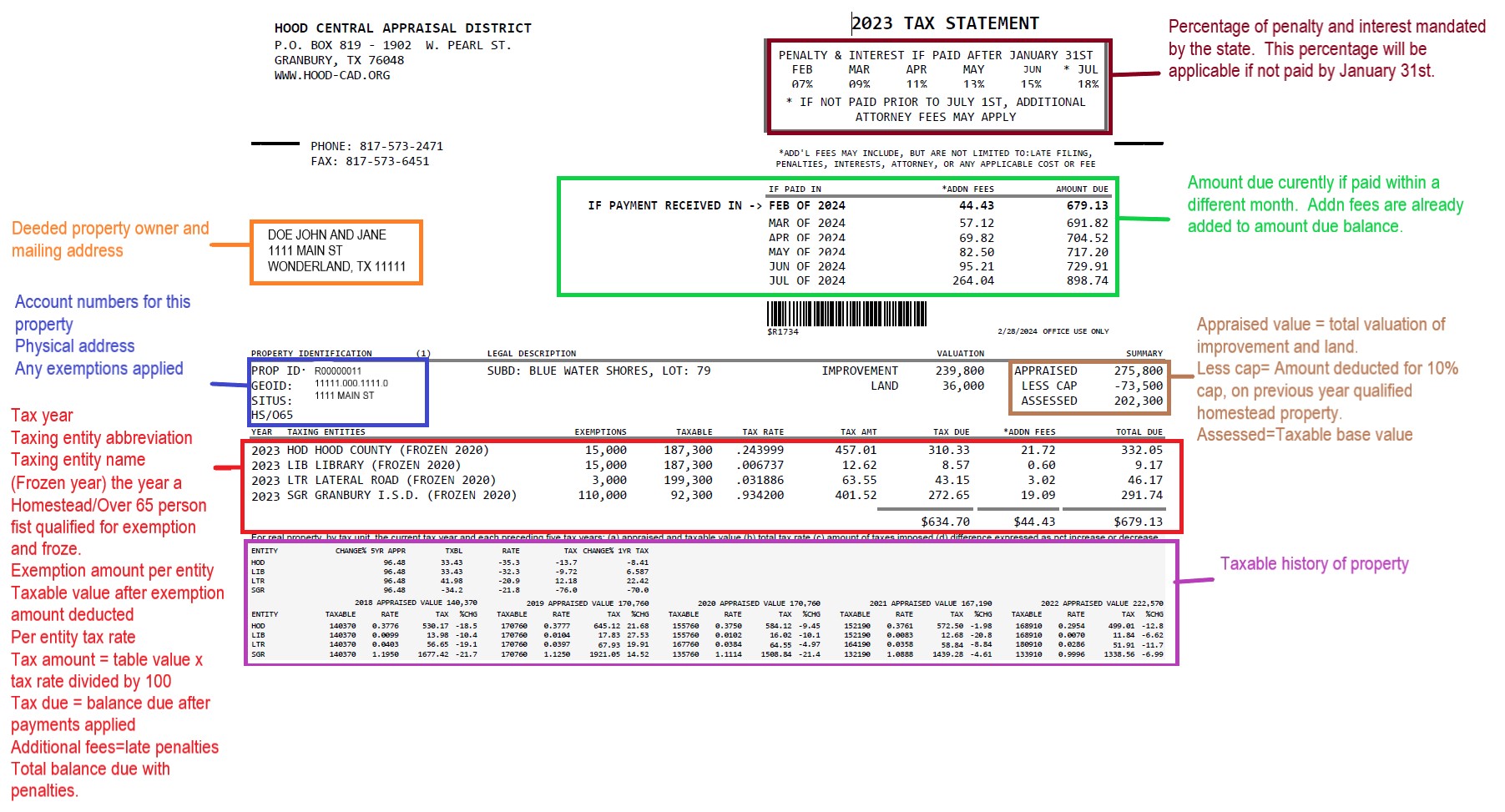
How do I read my new tax bill?
The State Legislature requires tax bills to contain a lot of data and information for the taxpayer. To better understand your tax bill click here for a graphic explanation.
Why is my statement on colored paper?
Prior to statements being mailed, mortgage companies and tax agents notify the appraisal district of any properties that taxes are escrowed through. If you have received a colored statement, this is a duplicate of the statement sent to your escrowing agent.
If I purchase a property during a tax year, how will I be billed?
Current year taxes are billed in October. These taxes are due upon receipt, but do not become delinquent until February 1st of the following year.
Property owners who have purchase their property prior to tax statements being mailed in October, will be credited a portion of the estimated taxes (figured by the title company), from the previous owner. The new owner of the property will be sent the full years statement in October. Any delinquent taxes should be paid by the previous owner at the time of closing. If delinquent taxes are not paid at this time, the new owner does become responsible for these taxes. Property being purchased after tax statements are mailed, should have a portion of taxes collected from both parties at the time of closing and sent to the Hood CAD by the title company, for payment in full. Your title company can answer any questions concerning how your taxes will be paid.
.
How do I set up paying my taxes on a quarterly basis?
Quarterly tax payment can only be set up on the 65 and over homestead or disabled person homestead exemption. To qualify for these payments, the first quarter payment must be made no later than January 31st. If you bring the payment in person, you can sign up at that time. If you are submitting a payment by mail, please include only one quarter of total taxes due along with a request to pay quarterly. Once, payment is received and processed a payment schedule will be sent.
When are property taxes due?
Property taxes are due once you receive them. However, you have until January 31st to pay before them become delinquent. Penalty and interest will be assessed on all delinquent taxes as mandated by the state law. Penalty and interest cannot be waived. The following is the state mandated penalty and interest associated with delinquent property taxes:

*Interest continues to accrue at the rate of 1% per month until the taxes are fully paid.
Why doesn’t Hood County offer a split payment option?
The split payment option has not been adopted by any of the local taxing units in Hood County. This option is not state mandated and action must be taken by local officials before it can be enacted.
What is a tax deferral?
A tax deferral is a legal process in order to stop the legal collection process of property taxes, or to abate a lawsuit to collect a delinquent tax, or abate a sale to foreclose a tax lien. The deferral process is applicable to the following:
The owner is 65 years of age or older, is disabled as defined by Section 11.13(m); or is qualified to receive an exemption under Section 11.22; and the property tax imposed is for a property that the individual owns and occupies as a residence homestead.
To obtain a deferral, an individual must file a deferral affidavit with the appraisal district. After an affidavit is filed, a taxing unit may not file suit to collect delinquent taxes on the property and the property may not be sold at a sale to foreclose the tax lien. Since this is a “deferral”, once the property owner no longer owns the property the tax must be paid within 181 days.
Note: Although a tax deferral will protect an individual from foreclosure for property tax. It does not keep any other lienholders from foreclosing on the property. In some cases a mortgage company may consider a deferral, a breach of the loan agreement.
Can I get a monthly installment plan to pay my delinquent taxes?
Yes it is possible, but there are certain qualification to satisfy. The installment agreement can only on your homestead property; you could not have entered into an installment agreement within the last 24 months; and one fourth of the taxes needs to be paid along with any other costs (i.e. court cost and abstract fees). The remaining balance would be paid out in 12 monthly payments.
What forms of payments are accepted?
Cash, checks, money orders, debit and credit cards. (We accept visa, Mastercard and American
Express). Debit and credit card users must pay an additional fee for the use of credit cards. The minimum fee is $2.50, however, most transaction have a fee of 2.5% for all card transactions. See the page on Credit Card Payment Information for a fee schedule.
What happens if the property owner and a mortgage company pay taxes on the same property for the same tax year?
The payment received first will be posted to the account. The secondary payment will be refunded to the payee or have the payment will be returned.
Can any person, individual or entity pay taxes on an account, even if they don’t own the property?
Yes. Anyone can pay taxes on any property. However, paying taxes on another’s property does not convey ownership or title of the property.
What is a tax ceiling certificate?
Property owners with 65 and older, or disabled persons, homestead exemptions enjoy a benefit know as a tax ceiling. This tax ceiling can provide a significant percentage of annual tax savings. This percentage of tax saving can be transferred from one homestead to another homestead.
If you are looking to move out of Hood County, the percentage of saving can be transferred to your subsequent homestead and potentially reduce your school taxes at the new homestead. If you are moving from one home to another home within Hood County, you can transfer the percentage of saving for school tax purposes and may also be able to transfer the percentage of saving for city taxes and county taxes. (Cities and counties are not mandated by law to provide a tax ceiling. This may vary from city to city and county to county.)
The “tax ceiling certificate” is the official document needed (from the original appraisal district) to notify the next appraisal district of your desire to establish a new tax ceilings on your next homestead.
What is a tax certificate?
A tax certificate is not the same thing as a tax ceiling certificate. A tax certificate is a document which indicates the current status of taxes, penalties, interest, and any known costs due on a property. The cost is $10.00 per certificate and it allow individuals know if there are any delinquent taxes still owned on a property.
What is a tax sales certificate?
Any individual that intends to participate in a property tax foreclosure sale, must obtain a tax sales certificate and provide it to the officer officiating the sale if they are the winning bidder. All bidders, that plan to participate in bidding, are required to provide the Appraisal District a list of all properties currently owned by the bidder within that county. The certificate certifies the bidder does not currently owe delinquent taxes on any property in the county in which the foreclosure sale is taking place. The fee for the certificate is $10.00 and can be used for up to 2 years.
Protest Questions
What are my remedies if I think my value is incorrect?
If you believe that your property value is too high or if you were denied an exemption or special appraisal valuation, you may file a protest with the Appraisal Review Board (ARB). If you do not agree with the decision of the ARB you may take your case to binding arbitration in some instances or to district court.
What are my remedies if I think my taxes are too high?
The local taxing unit adopt tax rates that determine how much tax you will pay annually. You may speak during public hearings when your elected officials are deciding how much revenue is needed and are setting the tax rate. While value is a component of the tax calculation, the tax rate is also a major part of the equation.
Can a protest be filed at any time?
No. The usual deadline for protest filing is on or before May 15th or 30 days after a Notice of Appraised Value was mailed, whichever is later. Late protests are allowed, if good cause can be provided for missing the usual deadline. Good cause is a reason beyond someone’s control, such as a medical emergency. The Appraisal Review Board (ARB) determines whether a property owner has good cause. The deadline for filing a late protests is the day before the Appraisal Review Board approves the records for the year. If the appraisal district removes, denies, issues a change of use, or preforms some other type of change to an account, the property owner will be given 30 days in which to file a protest opposing the actions taken by the district. The correspondence associated with the change, or notice, will provide the details on how a protest can be filed after the May 15th deadline.